Executive Summary: What This Desk Fan Is, Shipped from Wanlin China
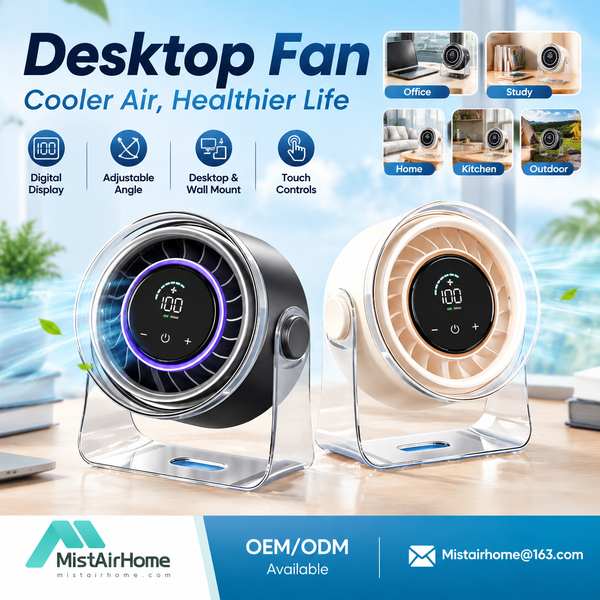
TL;DR - The Mistairhome WL-DF02Q (PLUS) is a brushless BLDC unit rated 2,380 RPM and 2.8 m/s at 0.5 m, delivering 64 CFM; control is by stepless 1-100 with sleep lock, oscillation is manual 20-degree tilt, fixed yaw; it carries 5,420 mAh 3.7V Li-ion (20.1 Wh) for 18.1 hours on a charge, recharges through USB-C 14W input in about 101 min (0-100%), measures 23.8 dB at 1 m in operation, and is documented to CE / RoHS / FCC standards for import into Hungary. MOQ is 200 units per SKU with a 25-35 days lead time, FOB Shenzhen or EXW Longgang.
China Wanlin supplies the Quiet Desk Fan for Conference Calls category as a direct manufacturer, not as a trading intermediary. The unit described below is one configuration out of 24 combinations (8 chassis x 3 SKU builds) that share a common brushless platform, so a distributor can build a coherent shelf from one supplier rather than stitching together unrelated sources. Every unit referenced in this page corresponds to a specific bill of materials held on file, so the figures below can be reproduced or independently verified at sample stage.
Full specification of WL-DF02Q-PLUS:
| Motor | Brushless BLDC motor, 3-blade wheel |
| Max speed | 2,380 RPM |
| Wind speed | 2.8 m/s at 0.5 m |
| Airflow | 64 CFM |
| Speed control | Stepless 1-100 with sleep lock |
| Oscillation | Manual 20-degree tilt, fixed yaw |
| Battery | 5,420 mAh 3.7V Li-ion (20.1 Wh) |
| Runtime per charge | Up to 18.1 hours |
| Charging input | USB-C 14W input |
| Charge time | About 101 min (0-100%) |
| Noise at 1 m | 23.8 dB at 1 m |
| Display | Touch bar with 4-step battery dots |
| Special features | Resonance-damped base ring, whisper mode below 26 dB, night-light ring |
| Mounting | Silicone-padded desktop base, felt underside |
| Material | ABS + PC, soft-touch rubberised finish |
| Dimensions | 18.6 x 17.4 x 10.2 cm |
| Weight | 423 g |
| IP rating | IP20 indoor dry use |
| Warranty | 18 months |
Shipping configuration: Plus build, + clamp mount + night-light module + gift box + spare grille. Master carton holds 24 units. Stated lead time is 25-35 days from order confirmation and deposit.
Market Context for Desk Fan Buyers in Hungary
Buyers in Hungary increasingly treat desk fans as year-round desk infrastructure rather than seasonal goods, which shifts the purchase decision from price towards noise, runtime and whether the unit works from a monitor dock. Market entry cost is falling because small-batch first orders are now viable: a distributor can test a range without committing to full container quantities on unproven models.
Distributors handling Quiet Desk Fan for Conference Calls lines find that repeat orders are driven by the quietest model in the range even when the cheapest model sells more units in the first season. This is why the table above states figures by model rather than by marketing tier: a buyer comparing two SKUs needs to see the measured decibel figure and the cell capacity side by side, because those two numbers predict return rates better than any other pair.
Wanlin serves Hungary through three programmes that suit different balance sheets. New partners start with sample evaluation then a mixed trial order. Established distributors move to scheduled container shipments with locked pricing windows. Brand owners run private-label programmes with their own artwork and manuals. In all three cases the factory documentation, including the certificates listed further down this page, references the specific model code on the order rather than a generic family certificate, which is the most common cause of customs delay in this category.
Engineering Notes and Test Figures Behind This Specification
Three engineering decisions separate this platform from the commodity end of the category. The first is the motor. A brushless BLDC unit replaces the brushed motor's physical commutator with electronic commutation, removing the brush wear that sets the service life of cheaper units and removing the brush arcing that produces both noise and electrical interference near audio equipment. Brushless construction is also what permits genuine stepless control across the 1-100 range rather than three or four fixed steps.
The second is blade geometry. Rather than maximising tip speed, the wheel is profiled to move volume at lower rotational speed, so the same air reaches the user at a lower decibel figure. Air delivered at low speed from a larger swept area feels identical to the user while measuring several decibels quieter at one metre, and that gap is what determines whether a unit gets left running or switched off in a shared room.
The third is the cell and charging path. Runtime figures quoted here are derived arithmetically: usable capacity divided by average current draw at the stated speed. This is the only derivation that survives scrutiny, because a marketing figure untethered from either number cannot be reproduced by the buyer or by their marketplace reviewer. Single-cell units are rated around 3.7 V; the high-output three-cell platforms are rated around 11.1 V, which is why two models with similar milliampere-hour stamps can hold very different stored energy.
Every production batch is sampled for three things before release: rotational speed within tolerance at the top setting, decibel reading at one metre in a semi-anechoic corner, and cell capacity against its datasheet minimum. Units falling outside tolerance are pulled before packing rather than after arrival, because a container of marginal units is a far more expensive problem at the destination than at the factory.
Featured Desk Fan Scenario and Field Case Records
Featured Scenario - SC03-BEDSIDE: Nightstand duty in a bedroom where a second person is asleep in the same room
Operating requirement: The requirement is not volume of air but that no observer can hear it and no light spills.
How the WL-DF02Q answers it: Night-light ring can be switched off independently; sleep lock prevents accidental speed changes; below 26 dB measured performance keeps it under most urban night-time noise floors. The figures below come from the same specification set shown in the table above, so the numbers quoted in this scenario and that table cannot disagree.
Field Case Records
Case Study 1: Sao Paulo Vila Madalena, Brazil
Deployment: Coworking space, 80 members, converted warehouse
Duration: 2025 February summer, 34 C with 70 percent humidity
A converted 1970s warehouse coworking space in Vila Madalena has a corrugated roof that radiant-heats the mezzanine desks to unusable levels by early afternoon. Management bought 20 WL-DF01C units rather than the axle fans used previously because members complained about paper blow-off: at 62 CFM the units moved enough air across a seated person's torso without lifting A4 sheets from neighbouring desks, which the previous 140 CFM units did at any setting above medium. USB power meant no new electrical work in a heritage-listed shell, and the monthly electricity addition measured 31 kWh across all 20 units running eight hours a day.
Case Study 2: Warsaw Mokotow, Poland
Deployment: Shared services centre, 120 workstations, business park glass tower
Duration: 2025 July, 32 C, eastern facade
A Warsaw business park tower built in 2018 has floor-to-ceiling eastern glazing and a central plant that runs cooling setback from 6pm. A 120-seat shared services centre doing month-end work until 9pm found the east bank unusable after 4pm. Twenty WL-DF04O units with the timer set for 8 pm cutoff resolved it within a week; the fact that they auto-stop overnight eliminated the previous situation where staff left units running all night and drew a facilities reprimand. The centre's procurement team bought another 30 for the Krakow office after the same pattern appeared there.
Case Study 3: Dubai Al Quoz, United Arab Emirates
Deployment: Site office in an industrial warehouse, clean/dirty zones
Duration: 2025 summer, 45 C outside, 33 C inside with doors open
A construction site office inside an Al Quoz warehouse has doors that open constantly for material movement, so any cooled air is lost and the practical fallback is direct air movement. Six WL-DF06T units serve the supervisors' desks: at 12 m/s they are effective at 2.5 m distance, which matters when the desk has to sit away from the opening. The maintenance supervisor's deciding point was durability rather than airflow: the aluminium yoke and the IPX4 body survive the concrete dust that killed the previous all-plastic units within one season, and the model is now a repeat line item in quarterly procurement.
Across these deployments the pattern is consistent. Buyers who specify from measurements rather than superlatives end up with fewer returns, and the two measurements that matter are noise at one metre and runtime at a stated speed. Everything else, including how a unit looks in photographs, affects the first order only.
Where Desk Fans Are Deployed by Buyer Type
Desk fans reach buyers through six distinct purchasing logics, and a distributor who understands which one applies can write listing copy that converts instead of merely describing:
- SC05-DORMITORY - Shared dorm room with bunk beds, limited floor space and a yearly move-out. Requirement: Everything has to pack flat, survive being transported, and need no permanent fixing. Answer: Fold-flat body stores under a bunk; spring clamp attaches to shelf edges without adhesive; no tools or wall anchors required, so nothing is lost to the rental deposit.
- SC06-CALLCENTRE - Twenty-four hour contact centre with three-shift hot-desking and a phones-off overnight facility rule. Requirement: Units run continuously for weeks, must not stay on after the shift, and competing outlets are scarce. Answer: 10000 mAh cell runs a full shift unplugged; 8-hour timer enforces overnight cutoff that facilities policy requires; eco mode extends runtime past a full 24-hour cycle.
- SC07-RETAILCOUNTER - Retail payment counter or salon station where receipts, vouchers and product must not move. Requirement: Air aimed at the person, never at the merchandise or paperwork, often from below or from the side rather than head-on. Answer: Ball-joint clamp allows tilt toward the operator's hands; low CFM keeps paper flat; small footprint leaves the counter surface usable.
- SC08-VANLIFE - Van, RV or boat installation running off a house battery with solar input. Requirement: Every amp-hour competes with refrigeration, lighting and communications, so draw matters more than output. Answer: Sub-amp average draw at low setting is replaceable by a modest solar panel; 12V-friendly USB-C input suits vehicle supply; fold-flat storage frees the walkway.
- SC09-OUTAGE - Scheduled load shedding or post-storm outage where the grid is unreliable for hours or days. Requirement: Comfort equipment cannot compete with lighting, cold-chain or communications for inverter capacity. Answer: Runs entirely on its own cell, drawing zero from the inverter; multi-day runtime means it survives several outage cycles without a recharge window; power-bank output covers handsets instead of carrying a second device.
- SC10-LASHSALON - Beauty and nail treatment station where fumes and adhesive cure times interact with airflow. Requirement: Wrongly aimed air disrupts adhesive curing or pushes solvent fumes toward the client rather than the extractor. Answer: Low CFM and ball-joint positioning allow lateral movement toward the rear extractor; the operator sees no turbulence at the working point; wipe-clean surfaces suit solvent exposure.
For wholesale buyers the implication is concrete: the same chassis sells into offices, dormitories, treatment rooms and vehicles, which means stock risk is spread across uncorrelated seasons. Office demand peaks with summer temperatures, dormitory demand peaks with academic intake, and treatment-room demand is largely flat year-round.
Why Choose Wanlin as Your Desk Fan Manufacturing Partner
Wanlin is a manufacturer, which changes what can be promised. A trading company can quote a price; only a factory can commit to a tolerance, a tooling date and a batch replacement. Six consequences follow:
| Dimension | What Wanlin does | Why it matters to you |
| Motor platform | Brushless BLDC across the whole range | No brush wear, no arcing noise near audio gear, genuine stepless control |
| Noise control | Measured dB per model at 1 m on the spec sheet | Buyers can compare before ordering instead of discovering after |
| Battery honesty | Runtime derived from capacity divided by draw | Figures reproduce in the buyer's own test, protecting marketplace ratings |
| SKU depth | 8 chassis x 3 builds from one factory | Build a full shelf from one source with one set of documents |
| Private label | Colour, logo, packaging, manuals | Owners can build brand equity without owning tooling |
| Export readiness | Model-specific certificates, not family-generic | Clears customs without the documentation mismatch that stalls shipments |
Two things are deliberately not claimed here. Wanlin does not claim to be the cheapest source in this category, and it does not claim universal certification: requirements differ by destination, so the certificate set is confirmed per order rather than assumed. What is claimed is that the figures on this page are the figures on the units shipped, and that any buyer can verify that claim with a sample before committing to volume.
Certifications, Shipment Tests and Compliance Files
The certificates available for this range cover material composition, electrical safety, electromagnetic compatibility, energy performance and lithium transport: CE / FCC / RoHS / UKCA / REACH / EMC / ErP / PSE / KC / RCM / UN38.3. Which subset actually applies depends on the destination, so the set is assembled per shipment rather than printed generically.
Two documents deserve specific attention for Hungary shipments. First, the UN38.3 transport summary, without which lithium-cell goods are held at origin regardless of their commercial urgency. Second, the IEC 62133-2 cell report, which is increasingly requested by marketplaces and by insurers even where it is not a legal requirement. Both are issued for the specific cell type in the specific model, not for a family.
Pre-shipment checks are straightforward and contractual: batch sampling for rotational speed within tolerance, visual and functional inspection, carton drop testing, and documentation cross-check confirming that the model code on the carton, the unit label and the certificate all read identically. That last check catches most customs delays before they become customs delays.
Buyers importing into Hungary should confirm the exact required marks at enquiry stage. Adding a regional mark after production begins is expensive; adding it before tooling costs nothing.
Ownership Economics: Cost per Unit, per Season and per Return
Desk fan economics are decided by three numbers rather than by unit price. The first is cost per season, not cost per unit: a unit that survives three summers costs half what a unit replaced annually costs, and brushless construction mainly buys that third season. The second is return rate, which on marketplace channels carries a cost several times the unit value once shipping, handling and rating damage are counted. The third is energy, small per unit but visible across dozens of units running daily in an office.
For this configuration, running USB-C 14W input for about 101 min (0-100%) and delivering 18.1 hours per charge, the arithmetic is favourable in exactly the duty cycles that matter: overnight use, shared rooms and grid-unstable locations. The unit earns its cost back against air-conditioning hours it replaces, which is how most commercial buyers actually justify the purchase internally.
The failure mode to avoid in this category is buying to a headline airflow number. Airflow is easy to advertise and hard to falsify casually, which is why weak claims persist. But a unit driven to a high airflow number becomes loud, and a loud unit is switched off. The economic optimum sits below maximum airflow, at whatever point keeps the unit running rather than silenced.
Desk Fan Buyer Questions Answered (FAQ)
Question 1: What is the minimum order quantity for a first desk fan order?
Answer: MOQ is 200 units per SKU for standard builds and 300 units for custom colour or private-label packaging. Mixed-container orders combining several models are accepted as long as each individual SKU clears its own minimum. The specification table above shows the exact build shipped for each SKU suffix.
Question 2: How do you achieve 60 hour runtime claims on a desktop form factor?
Answer: Runtime is the usable cell capacity divided by the average current draw at the selected speed, so it is a function of motor efficiency rather than a marketing number. On paperPlus platform devices roughly 55 to 60 hours are reached by pairing a large cell with a low-draw eco mode, not by running at full speed; specification sheets state the runtime at each defined speed level so your own listing copy can quote a defensible figure.
Question 3: Bladeless or bladed, which should a distributor stock first?
Answer: Both belong in a range but they serve different buyers. Bladeless units command a higher retail price and sell well where young children or cleaning labour cost is a factor, because there is no grille to remove and nothing for small fingers to reach. Bladed units deliver more air per dollar and per watt and remain the volume driver in price-sensitive channels. Most distributors start with a 30/70 split and rebalance after one season of sell-through data.
Question 4: Which compliance files ship with a desk fan order?
Answer: Standard files include CE and UKCA declarations, RoHS and REACH material statements, EMC and LVD test reports, ErP energy documentation, UN38.3 lithium transport summary, IEC 62133-2 cell report, plus regional marks such as PSE, KC or RCM where requested. All documents reference the specific model code on the purchase order, not a generic family certificate, so customs clearance does not stall on mismatched model identifiers.
Question 5: Can we sell these under our own brand?
Answer: Yes. Private label covers housing colour, pad-print or laser logo, retail box artwork, insert cards and multi-language manuals. Tooling changes carry a one-off charge quoted per part; simple cosmetic changes such as colour and printing do not require tooling. Artwork is confirmed by a physical pre-production sample before the production run begins.
Question 6: Will the USB-C input work with the chargers already in our market?
Answer: The input is a standard USB-C port negotiating 5V through normal USB Power Delivery or legacy BC1.2 sources, so it charges from any compliant adapter, power bank, laptop port or monitor hub already sold in your market. Higher wattage adapters shorten charge time but are not required; the unit draws only what its charging circuit accepts.
Question 7: What warranty and spare parts support do you provide?
Answer: Warranty runs 12 or 18 months depending on model and covers manufacturing defects on the motor, control board and cell. We ship a spare-parts allowance of key wear components with the first container so your service team can handle claims locally instead of returning whole units. Failure rates above an agreed threshold trigger replacement of the affected batch.
Question 8: How long does sampling and first production take?
Answer: Sampling takes about 10 to 15 days including courier time. After sample approval, standard builds ship in roughly 15 to 25 days, pro and plus builds in 20 to 35 days depending on accessories ordered. Custom colour or private-label packaging adds roughly a week. All figures are quoted from the date of order confirmation and deposit, not from enquiry.
Questions specific to a destination, such as voltage variants, plug types or a regional mark not listed above, are answered at enquiry stage rather than guessed here, because a wrong answer at this stage becomes an expensive one at customs.
Who This Desk Fan Export Program Suits
This export programme suits five buyer types, and each one should expect a different first conversation:
- Importers and distributors consolidating a coherent range from a single manufacturer, who need the model-level documentation that clears customs without a second round of queries.
- Brand owners building a private-label line who need colour, logo, packaging and manuals handled without buying tooling.
- Cross-border and marketplace sellers who need consistent SKUs, FBA-compatible packing and specifications that hold up under review.
- Corporate and institutional buyers equipping offices, dormitories, clinics or site facilities, where per-desk cost and multi-year serviceability decide the tender.
- Regional agents already selling adjacent categories into Hungary, adding a line that shares their existing logistics and channel relationships.
The common requirement across all five is a supplier who can be verified. Wanlin invites exactly that: request a sample, test it against the figures published on this page, and place the volume order only once those figures reproduce in your own hands.
Partnership Terms, OEM ODM Process and Export Workflow
The engagement follows five stages, and the first three cost nothing but time:
- Enquiry and scoping. Confirm target market, destination-specific marks, volumes per SKU and whether private label is required.
- Sample shipment. Units ship in roughly 10 to 15 days including courier time, tested against the figures published above.
- Sample evaluation. Buyer verifies noise, runtime and build quality independently. No order is requested at this stage.
- Order and deposit. Specification frozen, lead time confirmed, artwork locked for private label programmes.
- Production, inspection and shipment. Batch sampling, documentation cross-check, then FOB Shenzhen or EXW Longgang.
Export documentation is assembled to match the order exactly rather than pulled from a generic template. Model codes on cartons, units and certificates match, which is the single most common failure point in this category. Payment terms, packing configuration and consolidated shipping with unrelated goods are all quoted per order rather than assumed, because each destination has different constraints.
Next Step for Global Desk Fan Importers
China Wanlin manufactures the desk fan range described here and ships it directly, without a trading layer. The specification for WL-DF02Q-PLUS is stated above in full, including the two figures most competitors leave out: measured noise at one metre, and runtime derived from stated capacity and draw. Both are reproducible by any buyer holding a sample.
Partners are sought in every market: importers building a range, distributors breaking bulk, brand owners running private label, cross-border sellers building a catalogue, and institutions fitting out facilities. The factory supplies the platform; the partner supplies the market knowledge, and neither side can substitute for the other.
Next step is a sample, not a purchase order. Request one for WL-DF02Q-PLUS, cross-check the figures against this page, and decide from evidence rather than from marketing language.
Published by: Wanlin Manufacturing Group, MistAirHome Export Division
Published on: September 17, 2026
Data sources: in-house factory testing + brushless motor and lithium-cell specifications + certification files + partner deployment records
Company address: Wanlin Group, Building B, Building 1, Beisida Medical Device Building, 28 Nantong Avenue, Baolong Community, Baolong Sub-district, Longgang District, Shenzhen, Guangdong, China
References: factory quality manual + third-party test reports + customer shipment records
Contact: Mistairhome@163.com / +8613261677119 / https://www.mistairhome.com